Latest News & Updates

From Home-Built Austin-Healey Sprite to the Starting Grid at Oulton Park
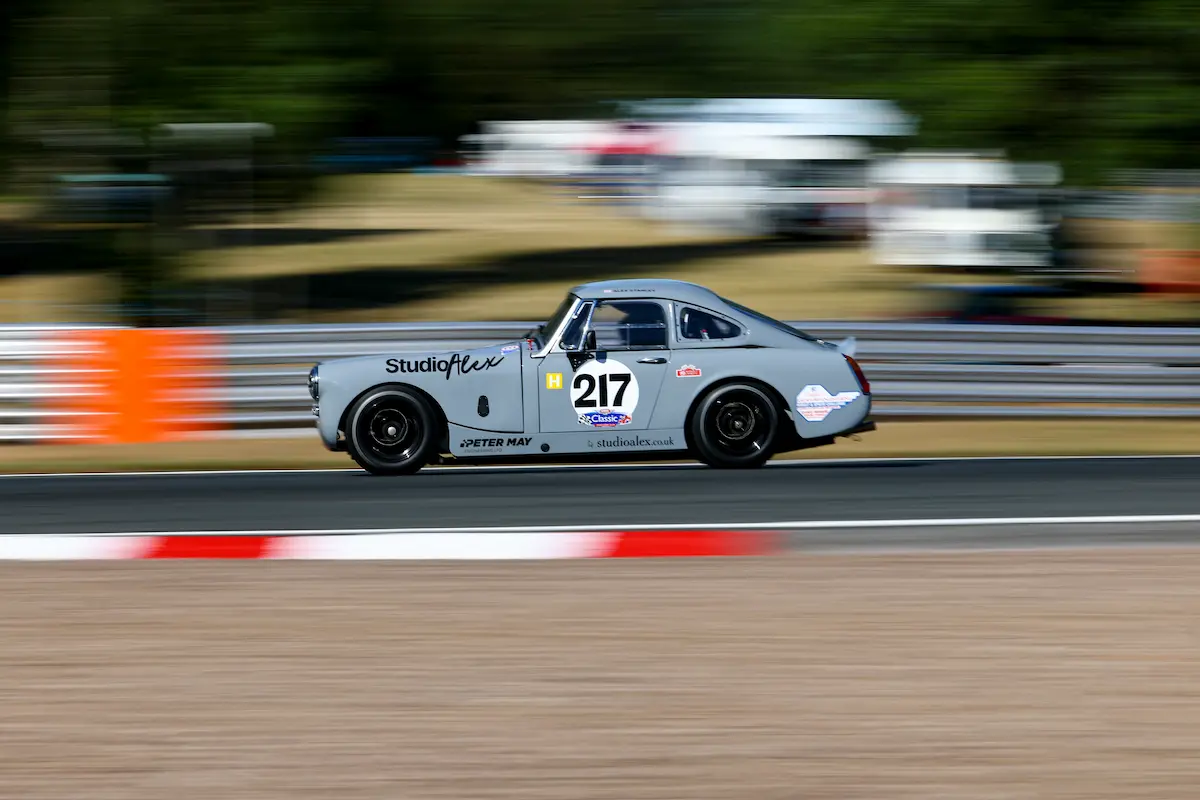
There is something particularly rewarding about seeing a long-term project finally make it onto a race circuit.
For the owner of Austin-Healey Sprite #217, reaching the grid at Oulton Park represented the culmination of a four-year project to build a historic competition car from a bare shell. For Midland Classic Restorations and Peter May Engineering, it was also the final stage of a journey we had been involved with for some considerable time, supplying specialist components, preparing the engine, setting up and developing the car and, ultimately, providing race support for its first competitive outing.
It is a slightly different story from many of the established historic racing cars we prepare and support, but one that demonstrates how the right specialist knowledge and support can help take an enthusiast-built project from the garage to the starting grid.
Starting with a Bare Austin-Healey Sprite Shell
Unlike many of the historic competition cars that arrive with us for preparation or further development, #217 wasn’t an established racing car.
The project began with a bare Austin-Healey Sprite shell purchased from Facebook Marketplace, with its owner setting himself the considerable challenge of building a historic Class H race car despite having no previous mechanical or motorsport background.
Over the following four years, the Sprite gradually came together, with Peter May Engineering supplying many of the specialist competition components required throughout the build.
Peter May Engineering’s extensive experience with competition Spridgets made them an important part of the project, helping ensure that the right components and technical knowledge were available as the car progressed from a bare shell towards a complete historic racer.
As anyone who has built a competition car will appreciate, however, assembling the components is only part of the process. Making everything work together reliably and getting a car properly set up for circuit use is another challenge entirely.
Preparing the 1275 A-Series Race Engine
At the heart of #217 is its 1293cc A-Series race engine, rebuilt and prepared as part of the work undertaken to get the Sprite ready for competition.
Engine preparation is a significant part of what we do at MCR, with our historic engine building services covering everything from standard road engines through to full competition builds.
Once the Sprite had reached the appropriate stage of development, the car was set up on our rolling road, allowing the engine and complete package to be assessed under controlled conditions before returning to the circuit.
For a newly built historic race car, this stage is particularly important. Rolling-road work isn’t simply about chasing a headline power figure. It provides an opportunity to assess fuelling, ignition, throttle response and the way the engine performs throughout its usable rev range.
Reliability and driveability are every bit as important as outright performance, particularly when preparing a car for a driver taking their first steps into competitive motorsport.
Our rolling road and carburettor setup facilities allow us to fine-tune these areas and establish a dependable baseline before a car heads back to the track.
Turning a Completed Build into a Race Car
With the engine prepared and the car mechanically complete, attention turned towards chassis setup.
The Sprite was string-lined and set up for circuit use, establishing a known baseline from which the car could be developed through subsequent testing.
This is where experience with competition cars becomes particularly valuable. A car can contain all of the correct components and still be a considerable distance from working as a cohesive package.
Alignment, geometry, ride height, tyre behaviour and damper settings all influence how confidently a driver can use the car. The correct setup will also vary depending on the specification of the vehicle, tyres, circuit and, importantly, the experience and feedback of the person behind the wheel.
The final stages of #217’s development therefore became a process of testing, learning and refinement.
MCR and Peter May Engineering continued to provide technical advice as issues were identified and resolved, helping turn what had originally been physically assembled at home into a properly set-up historic competition car.
It’s exactly the type of work covered by our historic race car preparation service. Not every customer needs a complete turn-key build. Sometimes an existing project simply needs another set of experienced eyes, the correct setup and specialist knowledge to complete those crucial final stages.
Taking the Next Step into Historic Racing
With the Sprite prepared, attention turned to perhaps the biggest step of the entire project: its first competitive race meeting.
Having completed only 13 trackdays before the event, the owner entered the final round of the Midget & Sprite Challenge at Oulton Park with the Classic Sports Car Club.
For somebody without a previous motorsport background, moving from trackdays into competitive racing introduces an entirely different set of demands.
There is the administrative and regulatory side of a race meeting, scrutineering and qualifying, but there is also the considerably different experience of race starts, competing for position and managing the car over an entire race distance.
It is one of the areas where having experienced support around both the car and driver can make an enormous difference.
MCR Race Support at Oulton Park
For #217’s first competitive weekend, Midland Classic Restorations provided full race event and trackside support at Oulton Park.
Our role was to look after the car and provide the technical support required throughout the meeting, allowing the driver to concentrate on qualifying, learning the procedures and, most importantly, driving.
The first objective was straightforward: successfully get both car and driver through their first complete race meeting.
The Sprite passed Motorsport UK scrutineering, successfully completed qualifying and went on to complete both 20-minute races.
There was encouraging progress on the stopwatch too.
Qualifying produced a lap approximately four seconds quicker than the car and driver had achieved during their previous visit to Oulton Park. Further progress followed during Race 1 before the quickest laps of the entire weekend arrived during Race 2.
Most importantly, after four years of building, development, testing and no shortage of challenges along the way, #217 took the chequered flag and returned home in one piece.
Supporting Cars and Drivers at Every Stage
Projects such as this demonstrate the different ways in which Midland Classic Restorations and Peter May Engineering can support customers entering historic motorsport.
Not every customer arrives looking for a complete competition car to be built from the ground up.
Some come to us with an established historic racer requiring further development. Others have completed much of a build themselves but need specialist knowledge to help take the project through its final stages. Some simply want experienced support at a race weekend so they can concentrate on driving.
We can become involved wherever that expertise is required.
Through MCR and Peter May Engineering, that can include specialist competition parts and technical advice, race engine building and preparation, rolling-road tuning, chassis setup, testing and ongoing vehicle development.
Once the car is ready to compete, our historic race event support can continue that relationship at the circuit, covering transportation, setup, trackside adjustments and running repairs throughout the meeting.
From the Garage to the Race Track
Four years after starting with little more than a bare Austin-Healey Sprite shell and an ambitious idea, seeing #217 complete its first race weekend at Oulton Park was a particularly satisfying result for everyone who had played a part in the project.
There will undoubtedly be more development to come. That’s part of historic motorsport.
But the original objective has now been achieved: a home-built Austin-Healey Sprite has become a scrutineered, competitive historic race car, and its owner has completed his first competitive race weekend.
For us, that’s an important part of what historic race preparation is about. It isn’t only about supporting experienced drivers competing at the front of international events. It’s also about helping new drivers and owner-builders take that first step into competitive motorsport with a car they can trust.
If you’re building a historic competition car, looking to develop an existing racer or considering making the move from trackdays into competitive motorsport, our team can help with everything from historic race car preparation and engine building to setup, development and complete race weekend support.
Contact Midland Classic Restorations to discuss your car, your next race meeting or how we can help get your historic racing project onto the grid.
Watch #217’s First Race Weekend
See Austin-Healey Sprite #217 in action at Oulton Park, from its first competitive qualifying session through to completing both races of the Midget & Sprite Challenge.
Video produced independently by a third party and shared here to document #217’s first competitive race meeting. Video content is not produced by or affiliated with Midland Classic Restorations.

Related Posts


We prepare & support drivers + cars in